
There’s an intimidating variety of mountain bikes on the market, and every type is suited to different terrains and riding styles. As a result, there’s a mountain bike for every rider—but which one is right for you? Read on to find out about the numerous factors that go into mountain bike design and how each can affect your ride.
Know Yourself, Know Your Bike
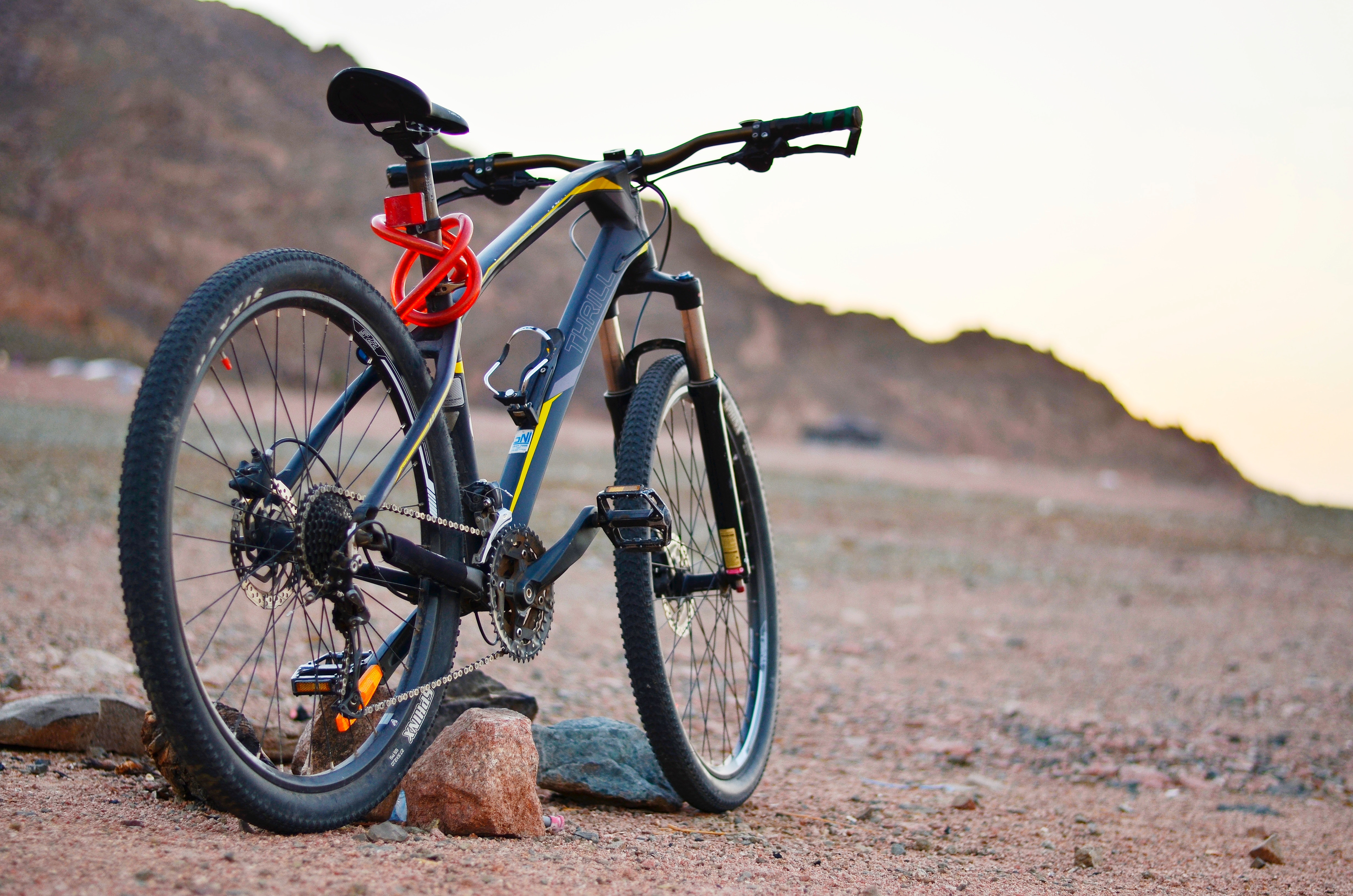
Photo by Haidan Soendawy on Unsplash
The title of this section is probably a little more “Zen” than you were expecting from a mountain bike guide but keep with us; understanding your riding style is a crucial first step in choosing a mountain bike. As there are so many types of mountain bikes available, knowing what you need for your particular riding style is essential for making a good investment.Before proceeding, ask yourself: “What kind of mountain biker am I?” Do you enjoy slowly making your way down a mountain incline while navigating upturned roots and large boulders? Or, do you imagine yourself making fast, tight corners on well-packed trails? Or maybe you’re one of an emerging breed of mountain bikers who would instead navigate sandy dunes or massive snowbanks.Whatever your riding style, there’s a mountain bike for you. However, a mountain bike made for rocky trails is usually very different from a mountain bike made for dirt paths. This fact is especially true for bikes built for dunes and snowbanks.Many new mountain bikers assume that tires are what sets different mountain bikes apart. While this is a good guess and somewhat accurate, tire size and tread are secondary considerations; when choosing between mountain bikes, the most crucial factor is the bike’s suspension.
Mountain Bike Design: Suspensions, Frames and Tires
Mountain bikes are usually categorized by their suspensions, with most models having a suspension system on either both wheels or just one. Bikes with no suspension are also common, though slowly falling out of favor. These three styles make up the three primary types of mountain bikes, but we’ll cover those later on. For now, it’s essential to focus on the technical aspects of the mountain bike’s suspension and its frame design.Like any bike, a mountain bike is made up of a frame, two wheels, a pedal drivetrain, and, of course, handlebars for turning. A mountain bike’s suspension, if it has one at all, is usually part of the “fork” that connects the bike’s wheels to the frame.
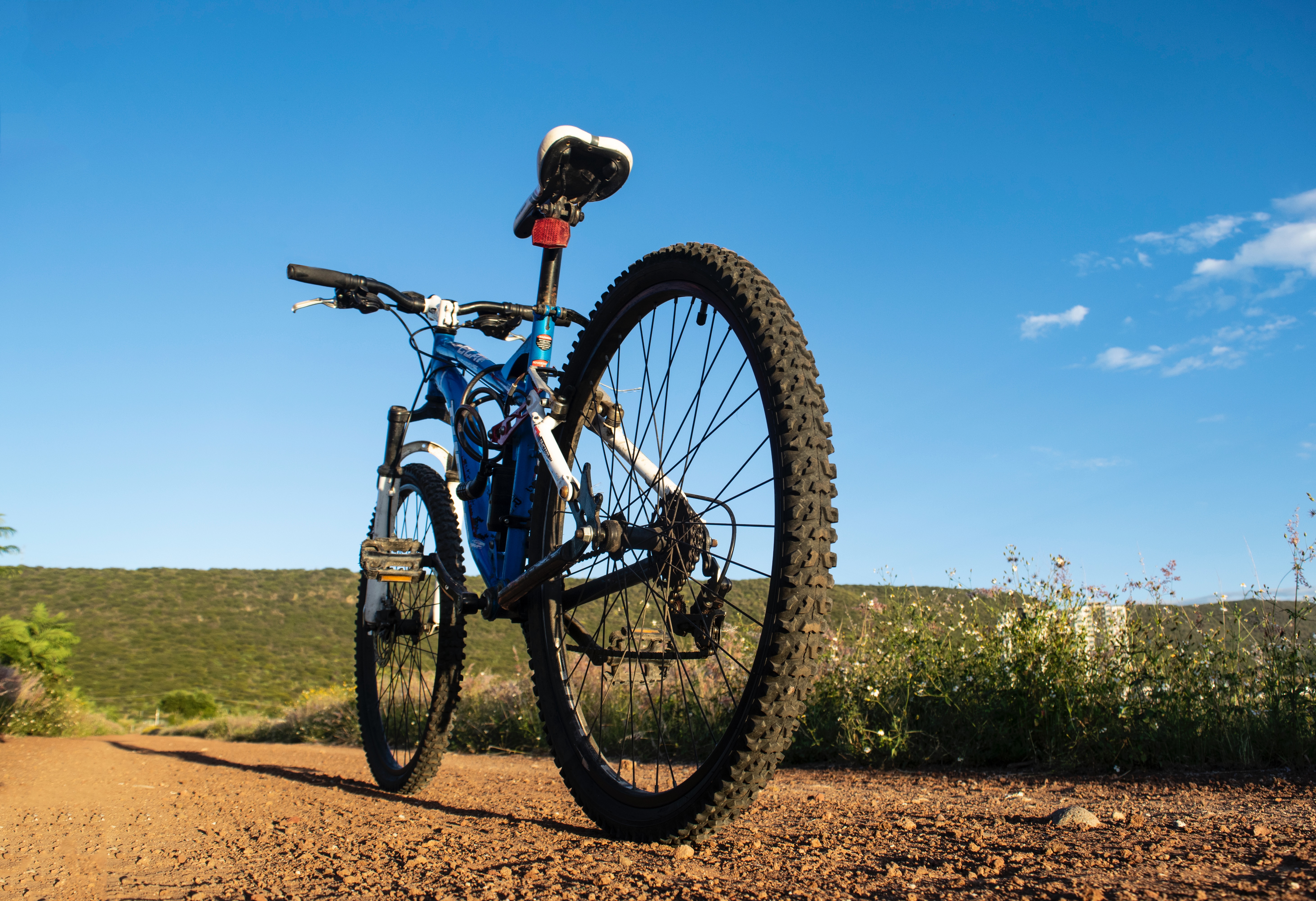
Photo by Jacqueline Martinez on Unsplash
The job of the mountain bike’s suspension is to help cushion impact over trails. Depending on its terrain, a suspension might be either desirable or undesirable. Depending on your riding style or the type of mountain biking you do, having an extra “cushion” to absorb shocks could benefit your ride; imagine going airborne and having a hard impact on an even harder surface! In such a case, you would probably want a suspension bike.Conversely, if you’re going up an incline and require stability, you might want little to no suspension at all. For these scenarios, many mountain bikes either have no suspension, a half or “hardtail” suspension, or an ability to “lock” their suspensions temporarily.It’s also worth noting the differences between the front and rear suspensions. While both types of suspensions perform similar jobs, their designs are fundamentally different. Front suspensions are relatively straightforward in their design, while rear suspensions are often much more complicated and varied in their design.
Front Suspensions
Front suspensions are most similar to the suspensions already described earlier in this section, consisting of a “shock absorber” system on the bike’s front fork. A bike’s front suspension will usually consist of either air springs or coil springs, the latter of which are the less expensive yet most durable option. Air springs, while less durable, are easily tuned and adjusted with precision. For the best of both worlds, many manufacturers offer front suspensions which incorporate both types in a single unit.
Rear Suspensions
The rear suspension is where things start to get complicated. The front suspension of your bike has a fairly straightforward job: it absorbs shocks. The rear suspension not only has to absorb the same shocks but must also absorb the forces from your pedaling and the majority of your weight at the same time! With so many crucial factors (literally) riding on them, rear suspension designs tend to be complicated and highly varied.The most common rear suspensions found on mountain bikes is the four-bar suspension, which, as the name suggests, consists of four connected bars. Here, two bars connecting to the hub of the rear wheel extend to two pivot points, which join two shorter bars. The shorter bars and their pivot points connect to a shock-absorbing system (such as an air or coil spring), which provides dynamic suspension on various terrains.While the four-bar design can vary between manufacturers, the basic principle is consistent across many mountain bikes on the market. Because of this, it remains the most common and versatile type of rear suspensions, with most other types working off of its fundamental principle in some way.Examples of four-bar variants include the faux-bar, the DW-link and the virtual pivot point (VPP) suspensions. Each of these types varies the four-bar suspension in such a way that makes it more functional for particular riding styles. The faux-bar suspension, for example, has its pivots under the rider’s seat stays.Other rear suspension types include single pivots and floating drivetrains, both of which are popular among individual users. Either way, almost all manufacturers vary the basic designs in some way, and certain types of suspensions may be better than another solely due to manufacturing quality. As a result, choosing a suspension comes down to more than just riding style—you’ll also have to consider the quality and reputation of the manufacturer.
Frame Design
Beyond the suspension, the frame itself is an especially important consideration when choosing a mountain bike. Baseline considerations include the frame’s weight and material, as well as more subtle design features. Perhaps the most important of these subtler features is the frame’s head tube angle.The head tube angle on a bike frame is the angle between the ground and the bike’s front forks. Just like with different suspensions, different bikes have different head tube angles, each of which has a significant effect on the bike’s handling.For example, a shallow or “slacker” head tube angle (less than 69 degrees) provides stability at high speed, similar to what one might expect from a motorcycle. A steep head tube angle (greater than 69 degrees), on the other hand, is better suited for rough trails and general climbing.If head tube angle becomes a factor in choosing a bicycle, follow this general rule: the harder the terrain, the steeper the head tube angle should be.
Wheels and Tires
It may seem ironic that we include wheels and tires as the last considerations in this section, but it’s no mistake: it’s easy to replace wheels and tires, but you can’t replace your frame without getting a new bike. Although frame and suspension are still the most important considerations when purchasing a mountain bike, wheels and tires warrant some discussion.The standard and original mountain bike wheel has a 26-inch diameter. This size is ideal for most conditions and is the default size on almost every bike on the market. Tires of greater diameters, such as 27.5- and 29-inch wheels, are best for more technical obstacles and careful handling.Wheel width is also essential to get the ride you want and largely depends on the terrain you plan to ride on. Most widths are around or under 2.5 inches, but some plus-sized and “fat” tires may have widths between 3.0 and 5.5 inches. Wider wheels are best suited for loose, “messy” terrain such as sand, mud and snow.In the next section, we’ll see how all of this technology condenses into three major categories of mountain bikes.
3 Major Types of Mountain Bikes by Suspension Type
If the previous section was a little (or a lot) overwhelming, don’t worry: All of the factors we’ve discussed are covered by three major types of mountain bikes. Of course, this isn’t to say that you shouldn’t remember factors such as your bike frame’s head tube angle, but choosing from one of the three types discussed below will be more than half of your decision process.
Full or Dual-Suspension Mountain Bikes
As the name implies, dual-suspension mountain bikes have suspensions on both the front and rear tires. This type is perhaps the most versatile mountain bike available, adapting to a wide variety of terrains while providing exceptional comfort to the rider.Many dual-suspension systems have a “locking” feature which allows riders to use a more rigid suspension for maneuvers such as climbing. Typically, however, tougher trails will demand tougher (and more flexible) suspensions. For these trails, full and dual-suspension bikes are ideal.
Hardtail Suspension Mountain Bikes
A “hardtail” suspension mountain bike has only a front suspension, resulting in a “hard” rear suspension (i.e., a hard tail). Due to the reduced weight resulting from having fewer suspension components, hardtail mountain bikes are best for riders who favor speed over maneuverability. By extension, hardtail mountain bikes are best suited for lighter terrains and smoother trails, but can sometimes be excellent for climbing.
Rigid Suspension Mountain Bikes
Despite technically being a type of suspension, rigid suspensions have no suspension whatsoever. Instead, “rigid” bars connect wheels to the frame, with any comfort resulting from the tires alone. Rigid mountain bikes may not seem to have many benefits, and frankly, they don’t; the only reason to choose one is for their lower weight and easier maintenance.
Finding the Mountain Bike for Your Riding Style

Image by ShonEjai from Pixabay
Here, riding style refers less to your personal “panache” while on a bike and more so the terrain on which you’ll be riding. In the coming sub-sections, you’ll notice that each type of riding suits a particular terrain and, as we’ve already discussed, will give you an excellent insight into what kind of mountain bike you should buy.
Cross-Country Riding
Cross-country riding is arguably the most popular style of mountain biking in the world, likely having been the first form of the sport ever invented. Here, bikers navigate well-packed trails explicitly meant for mountain biking, encountering various grades and the occasional obstacle.Cross-country bikers enjoy what is likely the most flexibility of any riding style. Since most trails are well-packed and well-defined, they’re suited for a much wider variety of bikes.Of course, trails aren’t just hard-packed dirt; cross-country trails are indeed cross-country, often including vegetation, small rocks and other types of obstacles and terrains. Typically, however, cross-country trails are relatively straightforward to navigate and have usually been human-defined (i.e., human-made) in some way.Human-made trails can also include human-made obstacles such as jumps and planks. Regardless, due to their human-made nature, cross-country trails are especially accessible to beginners with challenges increasing in level to that of the professional. But how can you tell them apart?Most cross-country trails are often “graded” using a color code. Green-marked paths are usually indicative of easy trails with no significant obstacles; blue-marked paths are somewhat more technical challenging; red or black paths are, as their color associations might suggest, often technically challenging and filled with many obstacles.Full-suspension mountain bikes are best suited for cross-country trails, as they will provide the most flexibility across the variety of terrains a rider is likely to encounter. For smoother trails with fewer obstacles, hardtail and even rigid mountain bikes may also be suitable.
Trail Riding
Think of trail riding as a “step-up” from cross-country riding; where cross-country trails are typically hard-packed and at least semi-manmade, trail riding involves riding trails—the very same enjoyed by hikers and mountain climbers. Because of this, riders can expect much rougher terrain, including large boulders, steep inclines and exposed roots.Due to the variety of terrains encountered with trail riding, a full-suspension is again ideal. Since speed is not so much of a factor here, riders will want to select a frame with a steep head tube angle for increased stability.
Other Types of Riding
While cross-country and trail riding are the two most common types of mountain biking, “niche” styles exist as well. Popular alternatives include downhill and all-mountain mountain biking, where riders try to achieve a combination of speed and stability while going down steep – and often rough – inclines. Other alternative terrains include dunes and snowbanks, which require the use of “fat” tires and special suspensions.
Conclusion
Image by Free-Photos from Pixabay
There’s a lot to consider when choosing a mountain bike, but as long as you know your riding style, you should easily be able to select one of the three suspension types. If you aren’t entirely sure, a full-suspension mountain bike with standard diameter tires will be capable of tackling most terrains. Happy riding!
Featured Image: Image by Free-Photos from Pixabay